
Transient Visitor Levy – Members Share their Views with the National Agritourism Strategy Board
Scotland’s National Agritourism Strategy Board meets quarterly to share activity and hear progress from the agencies around the table towards the sector KPIs outlined for 2030.
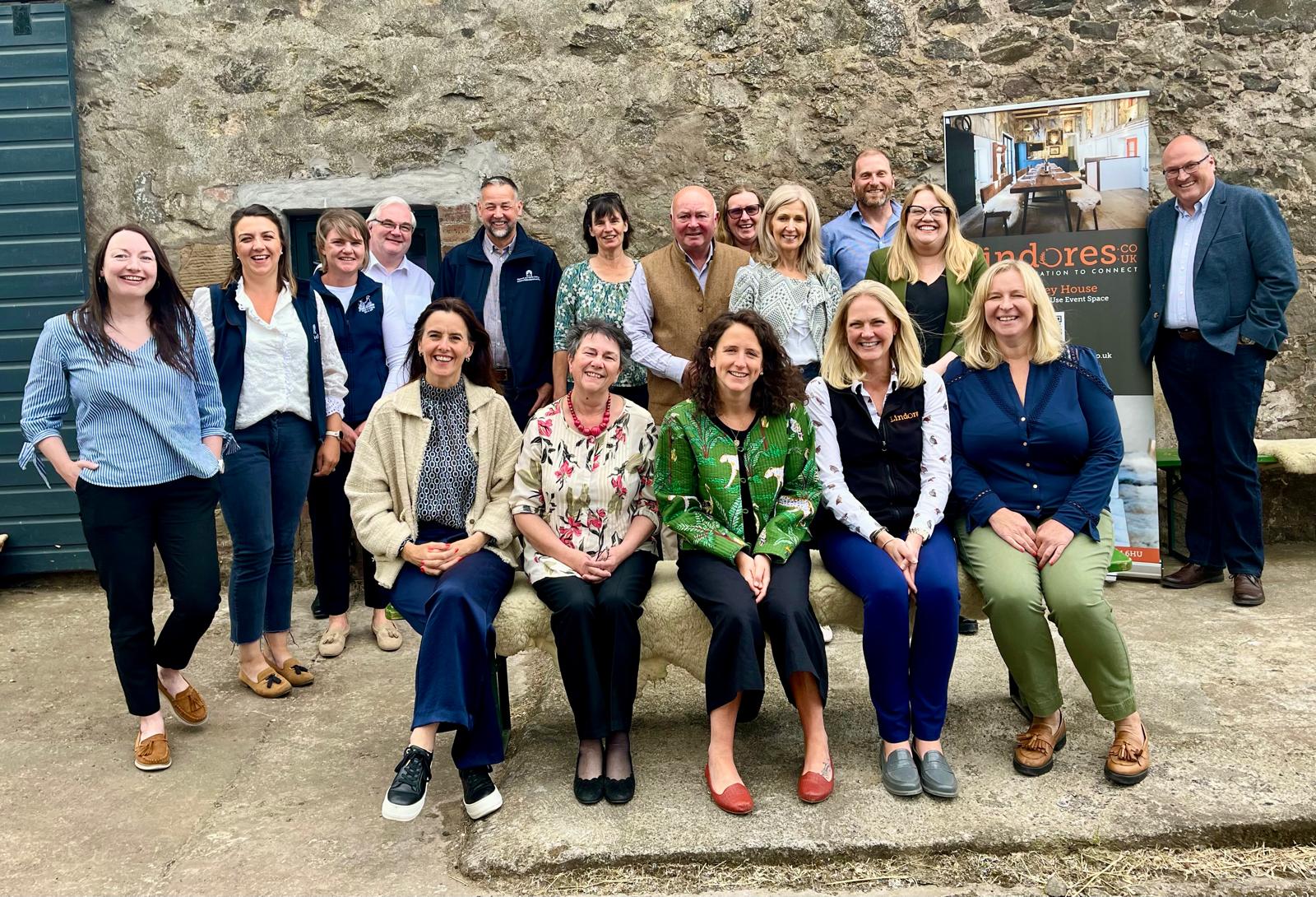
This week the group came together at Scottish Agritourism member business Lindores, in the beautiful Barley House. Huge thanks to our hosts Richard and Anna Black.
With consultation taking place in Perth & Kinross currently and many local authorities still to consider how it will be implemented, six Scottish Agritourism members from Perthshire, Angus and Fife joined the meeting to present strong evidence on the potential impacts of the Tourism Visitor Levy on their and other agritourism businesses.
The group provided a powerful unified voice highlighting several issues that will undoubtedly effect agritourism for consumers, operators and new entrants.
Andrew Donaldson, Comrie Croft, Perthshire
Comrie Croft is very much focused on using our farm as a resource that helps the local economy and it’s a place where other businesses can farm, and it enhances the environment and the community in that process. We’ve become the biggest employer in our local area – nearly 100 jobs in a remote, rural area, so it’s not an insignificant business.
Accommodation is the biggest income stream within that business so any new cost on that is certainly going to depress things in some shape or form for us and all the other associated feeder businesses as essentially, we create the market for them by bringing people into the farm. It just another layer of difficulty which disincentivises us to invest or other new businesses to set up.
I’m also concerned about the possibility of the percentage approach becoming a fixed fee, from our point of view, we’re focusing on the domestic market and the lower end of that, and a fixed fee of even a few pounds a night is quite a significant proportion if you’re camping and its only costing you £15 for the night compared to say, a few hundred pounds a night, if it’s a fixed fee on top of that, it becomes about fairness and a bigger cost for those on lower incomes which we are not for.
If it does happen, I think the important thing is that revenue is focused on enhancing the tourism product and not just providing toilets or things that people don’t actually come to Scotland for. For instance, in our area we really need better, interconnected, accessible paths for everybody – horse riders, walkers, cyclists, wheelchair users and so on and that’s something that does potentially attract people to an area.
Moira Henderson, The Rings, Fife
We are often used by people who are not actually ‘on holiday’ and therefore not tourists – they may not even be out with their own local authority areas, for example, today we have three people who are on holiday from Perth and they have five people with them who are their carers. They are not visitors, they are paid employees. That is a regular occurrence with us. We also on may occasions have people who stay because their regular accommodation, or their home, is being renovated. Also situations – and I’m sure all accommodation providers have experienced this – where people are staying because of an insurance situation and they have to be moved out of their property and its normally self-catering used for this, rather than a hotel accommodation.
The Rings has been open for almost ten years. We’ve expanded and invested. I will be lucky if my mortgage is paid by the time I’m 85, if I’m spared. I also now have to consider inheritance tax, national insurance increases, we ae being battered from every side possible and its just a battle and many are giving up – I can’t give up, we’ve invested too much – but we’re looking into whether we should transfer our business to be a trust or some other way of protecting the business so that the government can’t sock us at a later date and we just feel under attack.
I believe that Fife council is not dashing to do it. I would say they’re reluctant. They recognise that it is going to impact businesses and end up losing places for people to stay and they value tourism. I am going to use the word tourism rather than visitor, I have a major problem with the legislation and the word visitor which takes in a whole number of people that are already paying for services in this country and are being made to pay again. It’s a double tax.
We have schools that have taken overnight stays and residentials for children with special needs who have never stayed away from their parents for a night. It will impact so many people that is shouldn’t be. The councils are shutting down respite care facilities so our accommodation is being used for this and these people are not ‘visitors’.
Only 4% of those with disabilities would require my facilities which are wheelchair accessible but what about all the others that don’t need these? Often countryside locations – I have seen the impact, one young man with challenging behaviour hadn’t had a break in seven years that the carer had been looking after him and she was determined he would get a break. Within 20 minutes of being at the rings, he had gone from rocking back and forth to relaxed, reclining with feet up. His carer had never seen him in that position and that’s the impact that agritourism businesses can have on people.
5% on top of a stay might mean another stay in a year that a family can’t have.
Anna Black, Lindores, Fife
Scottish Agritourism Destination Leader Fife
The way our business model operates is that we create spaces to allow others to thrive, so we don’t employ services such as a chef or masseuse;, I use contractors and if we apply a levy on our overnight stays, its just adding more expense for the consumer and consumers have got so much choice – they can go abroad these days for cheaper – and at the moment the domestic stay-caytion market is tough and every penny counts, so if a levy is applied and visitor numbers decrease, there will be a ripple effect on the rural community. I will essentially not be able to pay for all the contractors that we’re using as we’ll be pricing ourselves out of the market. I’m not coming at this from ‘just me’. This is on behalf of all our local heroes that the levy is not a small amount and it will have a compounding effect on the local community, to all of our suppliers that help create our experiences so I would be very cautious and worried for them and their loss of income.
It gets to the point where you do think, what’s the point of being busy fools? We’ve built houses rather than cabins so we can convert them to long term lets but we absolutely don’t want to do that so I’d be cautious of driving margins so low that we stop creating experiences in the rural economy and for the area.
We also get a lot of charities using our facilities. Pony clubs, riding clubs, schools. Young people that come to stay and ride. Kids need to do sports, they need to be able to do activities, for pleasure or progression and they are not tourists. They are charities or clubs that fundraise to be able to come here for camps and creating an additional cost for them to do so makes me very sad.
Lesley McArthur, Glen Clova Hotel and Lodges, Angus
From our point of view, we’ve already had the Visitor Levy highlighted to us in the Angus area, and we would strongly oppose it. Primarily because our visitors are not all tourists to the area, the only time we’re welcoming international guests is probably from April to September, otherwise a lot of our guests are local people who are coming to us for a staycaytion or possibly a shoot on the estate.
It’s just another addition onto an already expensive time for people to stay with us – national insurance increases, all of our suppliers are constantly putting up prices, the minimum wage has gone up; it’s just another figure to have to add on to our prices. We vary from nightly stays in the hotel to short breaks in the lodges which are probably deemed as luxury or premium priced product and it’s not something we can just take off our profit line. Our profit line is already squeezed to the maximum. It’s just not something we feel is feasible at this point in our business.
Aylwin Pillai, Kinclune House and Estate, Angus
Kinclune House is a baronial mansion which we opened in 2023, and our best customers for our summer holiday breaks season are international – coming from America, India, Mexico, you name it – and we just can’t take a potential 5% off our margins so we’d be adding on the expense to their holiday, adding over £300 when we’re already not competitive with other European countries, so I’d be very worried about that.
Another issue for me is I don’t know what impact this will have on the other side of our diversification which we’ve just opened which is weddings. Our margins for winter weddings in particular are tiny so because we are advertising prices now for 2028, if at some time between now and 2028, we have to absorb a 5% visitor levy, this will really wipe out our margin.
I spent a significant amount of money on a fancy website but I get very few direct bookings; you really have to massively invest in your website to compete with letting agents and you can’t. So letting agents take close to 20% of sales, plus 20% VAT and a 5% visitor levy would just wipe us out.
Jan Dixon, Solsgirth Home Farm, Perth & Kinross
Scottish Agritourism Destination Leader Perthshire
Solsgirth Home Farm is in a unique location, right on the edge of Perth & Kinross, part in Clackmannanshire, part in Fife. We started up about six years ago. We’ve renovated a lot of the houses around the farm and farmhouse accommodation which we eventually got an STL for.
As far as one of our local authorities is concerned, the amount of revenue brought in from the levy will not cover the cost of the admin for implementing and its not viable.
Adding together all the costs of operating – STLs, National Insurance, Council Tax, advertising through agencies, there is not an awful lot left.
We can’t really see a purpose – that we in the rural community – would use that money for.
Tessa Sands, Oakfield Farm, Perth & Kinross
I am a new entrant to farming and fairly new to agritourism. In November 2023, I was part of the under 35’s scholarship programme with Scottish Agritourism and that was my first introduction to the network.
We have built a farm – whole other issues as first generation farmers – we bought a small 35acre plot of land and we’ve built a base for our farming enterprise. We do rent about 100acres now as well and we’ve built that up over three and a half years.
We launched with a five-year business plan. We do seasonal events and tours. Our biggest enterprise is lambing tours in March and April over three weekends we welcomed just under 1000 people to the farm, to learn about food and farming and I’m very passionate about getting people to the farm.
For our next step, we are building a house and we hope that in September we can move into that. We have an existing lodge that we live in and have planning permission for another and we have plans to do short term holiday rentals with these but since we did our business plan three years ago, the costs have spiralled. If we were to do this at today’s costs, there really isn’t anything in it.
We already work for below minimum wage and if I have to pay a cleaner and todays rates, its not worth us doing that so we’re now re-evaluating what we’re doing and we will probably not put up a second lodge and we will do longer term rentals in the existing lodge and look at remodelling our plans.
It’s hard; I think everyone in the rural sector does this because we enjoy it. I gave up a ‘normal’, good career and we want to have the public to our farm, we want to do this and this levy is a definite deterrent for new entrants. I can’t be the only person with plans thinking that they’re not worth it – I can’t work for nothing.